
We're a little over two weeks out from Launch 2.0 on November 1st, and the forehead list is holding second in the zone race this morning (full standings at the bottom). Today's question is one the internet loves to answer too confidently: are those tiny forehead bumps fungal acne? Maybe — but probably not in the way most posts mean. Those small, uniform, sometimes-itchy bumps across your forehead can be "fungal acne," but they can just as easily be ordinary clogged pores, and you can't tell for certain from a phone screen.
So are my forehead bumps fungal acne or regular acne?
Honestly, you often can't tell by looking — the two can look nearly identical on a forehead. And "fungal acne" isn't really acne at all; it's a folliculitis driven by a yeast that lives on everyone's skin.
Regular acne is a mix of oil, dead skin cells, and bacteria clogging a pore, and it tends to show up as a variety of things — whiteheads, blackheads, the odd deeper bump, different sizes in different spots. Malassezia folliculitis (the proper name for "fungal acne") is an overgrowth of that normal skin yeast inside the hair follicles, and it tends to look monotonous: lots of tiny, same-size bumps in clusters, often itchy. This is educational, not a diagnosis.

What makes fungal acne look different from normal pimples?
A few telltale patterns: the bumps are usually small and uniform, they often itch, and they cluster rather than popping up one at a time. Ordinary breakouts are more of a mixed bag in size and type.
Fungal folliculitis also tends to flare with heat, sweat, and anything that traps moisture against the skin — and sometimes after a course of antibiotics. That said, the overlap with regular acne is real, which is exactly why guessing from a mirror is a coin toss.
Why does the forehead get this so often?
Because the forehead is warm, oily, and spends a big chunk of the day trapped under hair, hats, and sweat — the exact damp, occluded conditions that yeast is happy in.
The forehead sits in your T-zone, where oil glands are packed in tight, and that yeast feeds on oil. I'm a gym guy and a Sunday runner, so I know the drill: a sweaty headband, a hat brim, or bangs stuck to a damp hairline keep that strip warm and sealed for hours. None of that proves your bumps are fungal — but it's why the forehead and hairline are such common real estate for the look-alike.
Can you treat fungal acne like regular acne?
Usually not — and that's the whole reason the distinction matters. The moves that help ordinary pimples often do nothing for yeast-driven bumps, and a few rich oils can even give the yeast more to feed on.
A standard acne routine is aimed at oil, clogs, and bacteria, not at a fungus, so people with folliculitis can scrub and spot-treat for weeks and watch nothing change. Sorting out which one you're dealing with isn't a job for a confident Reddit thread — a dermatologist can actually look at it and point you at the right approach, and that's the honest answer here. We make a cosmetic patch, not a treatment, so I'm not going to pretend otherwise.
What should you actually do about stubborn forehead bumps?
Keep your routine gentle, stop scrubbing (it irritates without helping), and if a uniform, itchy spread won't settle no matter what you try, get a dermatologist's eyes on it rather than guessing for another month.
The everyday basics still earn their place: rinse your forehead after a sweaty workout, wash the headbands and hats that sit on it, reach for breathable fabrics, and keep your fingers off whatever comes up. Those habits lower the warm-and-damp odds without you having to diagnose anything.
Where does a pimple patch fit in?
On a single surfaced whitehead — not on a field of tiny fungal bumps. A hydrocolloid patch is known for covering a spot that's come to a head, absorbing the fluid it gives off, and keeping your fingers off it while it settles, and that's a real job on an ordinary forehead pimple.
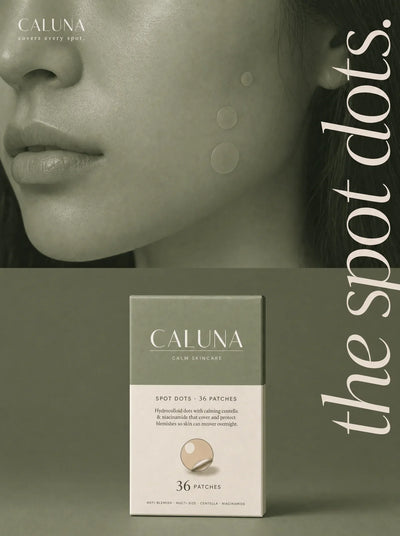
For that everyday spot you can see today, our Spot Dots are the thing I keep by the sink — press one onto clean, dry skin and leave it 6 to 8 hours or overnight. For the weeks an ordinary breakout spreads across the whole forehead as a band, a single wide patch beats dotting six circles across your hairline: The Forehead Patch is coming in November — join the forehead list. It's a simplified hydrocolloid formula, with the final ingredient list published at launch. On look-alike fungal bumps, though, a patch only covers and protects — it isn't the fix, and that's a dermatologist conversation.
Race update: nose 3 · forehead 2 · chin 1 · kids 1.
The zone with the most names launches first on November 1st — pick yours.
— Jake, founder of Caluna.