
It's late September as I write this — about five weeks out from Caluna's November 1st launch, with the nose still running ahead on the zone race. So here's a nose habit I get asked about all the time: if you're scrubbing your nose hard to fight the shine and the little dots, you're almost certainly overdoing it. The nose is the oiliest zone on your face, and scrubbing it raw tends to leave it oilier and redder, not cleaner.
Can you scrub your nose too hard?
Yes — and it's one of the most common mistakes people make on that exact spot. Over-scrubbing strips the surface of the skin, and stripped skin usually answers with more oil, not less.
The nose feels greasy and looks dotted, so it's tempting to go at it twice a day with a stiff brush, a rough washcloth, or a gritty scrub. But you can't buff oil glands into behaving. Hard scrubbing just roughs up the surface while the glands underneath carry on exactly as before.
Why does scrubbing make an oily nose worse?
Because scrubbing clears the oil sitting on top but never touches the glands producing it — so your skin reads the surface as "too dry" and makes even more oil to compensate.
You end up in a loop: scrub, feel tight for an hour, then get shinier than before by lunch. Meanwhile the friction leaves the nose pink and flaky, and on skin that already breaks out, that extra irritation can turn a calm nose into a bumpy one.

Will scrubbing get rid of the dots on your nose?
No. Most of the tiny grey-tan dots along the sides and tip of your nose are sebaceous filaments — a normal way your skin channels its oil — not blackheads, and scrubbing won't clear either one for good.
Sebaceous filaments are supposed to be there; they refill within a day or two no matter how hard you scrub, which is why the nose can feel like a losing battle. True blackheads are oxidized clogs, and they're a different story — but grinding at them with a scrub just irritates the skin around them. This is education, not a promise: a patch doesn't remove filaments or blackheads, and neither does a rough cloth.
What about a pore brush or an exfoliating pad?
Used gently and once in a while, they're fine. Used hard and daily on the nose, they're a fast track to a red, over-stripped, more reactive spot.
If you like the ritual, go light — a soft touch a couple of times a week beats a daily scrub-down. More pressure isn't more clean.
How should you actually clean an oily nose?
Gently. Cleanse with your fingertips, blot the excess oil through the day instead of stripping it, and stop when the skin feels clean rather than tight.
- Wash with your fingertips, not a brush — a soft cleanser worked into the creases beside your nostrils reaches more than a rough pad ever will.
- Blot, don't scrub. A blotting paper or clean tissue pressed on midday lifts the shine without drying you out.
- Skip the "squeaky clean" feeling — if your nose feels tight after washing, that's stripped, not clean.
- Keep your fingers off the dots. Picking and squeezing does more visible damage than the oil ever did.
What if you've already scrubbed your nose raw?
Ease off completely for a few days and let it settle — no scrubs, no strong new actives, just gentle cleansing and patience.
Skin recovers on its own once you stop provoking it. If your nose stays painful, cracked, or won't calm down no matter how gentle you are, that's a good moment to see a dermatologist rather than keep experimenting. I make cosmetic patches, not medicine, and some things need a professional's eyes.
Where does a patch fit — and what's coming?
A patch isn't for the scrubbing itself; it's for the raised whitehead that sometimes flares up afterward. Hydrocolloid is known for covering that kind of spot, absorbing the fluid, and keeping your fingers off it so the skin underneath can feel calmer.
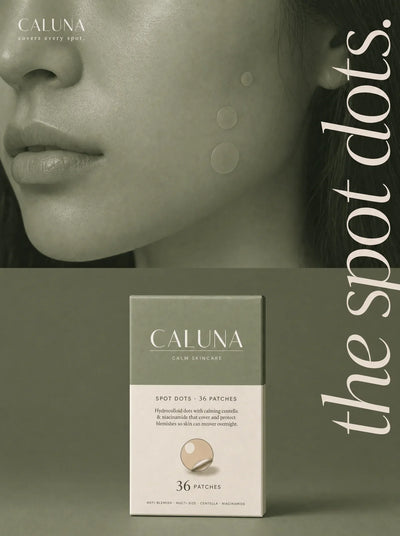
For a single surfaced spot today, our Spot Dots are the nearly invisible round dots we make for exactly that — 36 to a box, free US shipping. And because a flat dot slides right off the curve and creases of the nose, I've been building a patch shaped for it: one T-shaped piece that covers the bridge and hugs down both sides. The Nose Patch is coming in November — join the nose list to help decide when it launches. It runs a simplified hydrocolloid formula, with the final ingredient list published at launch.
Race update: nose 3 · chin 1 · forehead 1 · kids 1.
The zone with the most names launches first on November 1st — pick yours.
— Jake, founder of Caluna.