
Short answer: maybe not. A lot of what looks like stubborn forehead acne isn't acne at all — it's often what people loosely call “fungal acne,” and the reason your usual spot products aren't touching it is that it's a completely different thing. Telling the two apart is the difference between spinning your wheels for months and actually getting somewhere.
It's early September as I write this, about two months out from our November zone launch, and the forehead is still the underdog on the waitlist — so here's a forehead question I get constantly, laid out honestly. Quick disclaimer up top: I'm a plumber who makes pimple patches, not a dermatologist, so treat this as a plain-English explainer, not a diagnosis.
What is “fungal acne,” exactly?
It isn't really acne. The proper name is Malassezia folliculitis — an overgrowth of a yeast that naturally lives on everyone's skin, which gets into the hair follicles and causes a rash of small, uniform bumps.
Regular acne is a pore clogged with oil and dead skin, where certain bacteria play a role. “Fungal acne” is follicles irritated by yeast. They can look similar from across the bathroom, but they're driven by different things — which is exactly why they don't respond to the same routine.

How can you tell fungal acne from regular forehead breakouts?
The biggest tell is uniformity. Fungal folliculitis tends to show up as lots of small bumps that are all roughly the same size, often itchy, clustered across the forehead and hairline — while regular acne is a mix of sizes, with the odd whitehead, blackhead, or larger sore spot.
A few other clues people notice: it often flares after sweating or wearing a hat for hours, it can feel more like an itchy rash than a few angry spots, and it stubbornly ignores the acne products that usually do something for you.
Why won't my usual acne products clear it up?
Because they're aimed at the wrong target. Ingredients known for helping with clogged-pore acne are built around oil and skin-cell buildup, not a yeast overgrowth in the follicle, so they can leave fungal folliculitis completely unbothered.
That's not a discipline problem — it's a sign you might be dealing with the wrong condition, and a good moment to stop guessing and see a dermatologist who can actually look at it.
Why is the forehead such a hot spot for it?
Heat, sweat, and cover. The forehead sits in your oily T-zone and spends its day under hats, headbands, helmets, and bangs — warm, damp, covered-up conditions are exactly what lets that yeast get comfortable.
I'm a gym guy and a Sunday runner, so I know the pattern: sweaty hat, no rinse, and two days later the hairline is speckled. Keeping sweat from sitting — a quick cleanse after a workout, a clean dry headband, rotating your caps — is good skin sense either way, whether the bumps turn out to be fungal or plain old friction.
So what actually helps day to day?
Honestly, the useful move here is to get it identified rather than to keep improvising. If it's genuinely Malassezia folliculitis, it's handled differently from acne, and a dermatologist can point you at the right approach instead of a longer aisle of the wrong one.
In the meantime, the low-risk basics don't hurt anyone: don't let sweat dry on your skin, keep the gear that touches your forehead clean, go easy on heavy hair products right at the hairline, and keep your fingers off. None of that is a fix — it's just removing the conditions the bumps like.
Do pimple patches help with fungal acne?
Not really, and I'd rather be straight with you than sell you something. A hydrocolloid patch is made to cover one surfaced whitehead — it's known for absorbing the fluid a spot leaks and keeping your fingers off while the skin settles — not for a field of tiny uniform bumps.
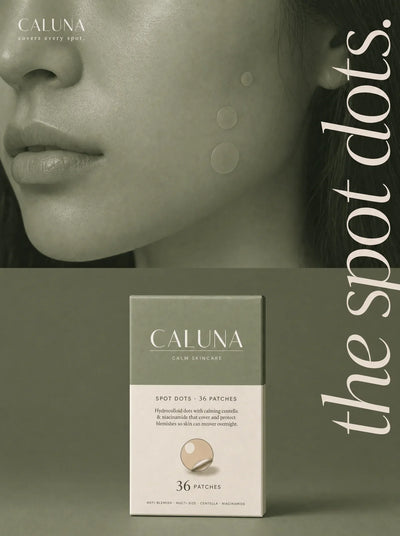
Where a patch earns its place is the everyday spot that does come to a head: cover it, let it feel calmer, stop the picking. That's what our Spot Dots are for right now. And for foreheads that break out in the ordinary way, spread across the whole zone, the Forehead Patch — one wide patch instead of six scattered dots — is coming in November: join the forehead list. It'll be a simplified hydrocolloid formula, with the final ingredient list published at launch. But if your bumps are itchy, uniform, and stubborn, a patch isn't the answer — a dermatologist is.
Race update: nose 3 · chin 1 · forehead 1 · kids 1.
The zone with the most names launches first on November 1st — pick yours.
— Jake, founder of Caluna.