

Here's the honest answer: most of the tiny dots scattered across your nose aren't blackheads at all — they're sebaceous filaments, a normal part of how oily skin works. Blackheads are clogged, oxidized pores; sebaceous filaments are the thin, oil-filled channels nearly every adult has on their nose, and they're not a flaw to fix.
It's about three weeks until our Launch 2.0 on November 1st, and the nose is sitting near the front of the zone race right now — so this one's close to home. Let me break down what's actually on your nose.
What's the difference between a blackhead and a sebaceous filament?
A blackhead is a pore plugged with dead skin and oil that has oxidized at the surface and turned dark. A sebaceous filament is a natural, hair-thin lining of oil inside the pore — usually gray or tan, not a true black.
The quick tells: blackheads show up as scattered, distinct dark bumps you can usually feel. Sebaceous filaments sit flush with the skin in an even, almost patterned spread — most often right down the sides and tip of the nose — and they refill on their own within a week or so.

Why does my nose have so many of them?
The nose carries one of the highest densities of oil glands anywhere on the body, so its pores are simply busier and more visible than the skin on your cheeks. More oil moving through a pore means a more noticeable filament.
That's also why the T-zone — nose, forehead, chin — looks shinier by midday. It isn't poor hygiene. It's anatomy, and it tends to run in families.
Can you get rid of sebaceous filaments for good?
No. They're a normal structure of oily skin, not a blockage, and they come back within days to weeks no matter what you squeeze, strip, or scrub.
You can empty one temporarily — a pore strip or a squeeze will pull some oil out — but the pore fills again fast. Going after them hard is where people get into trouble: over-squeezing and over-scrubbing can irritate the skin and leave a pore looking larger than before.
So should I even bother with them?
If they aren't red, raised, or sore, there's nothing to deal with — they aren't acne, and chasing them usually leaves your nose angrier than it started. Save your effort for actual breakouts.
A gentle, consistent routine does more for how your nose looks than any aggressive one. Washing once or twice a day and keeping your hands off beats a weekly scrubbing session every time.
What about a real pimple on my nose?
When a pore does turn into a genuine, inflamed breakout, the most useful thing you can do is stop touching it and cover it. A hydrocolloid patch is known for absorbing the fluid from an open spot and keeping fingers, oil, and bacteria off it while it settles down.
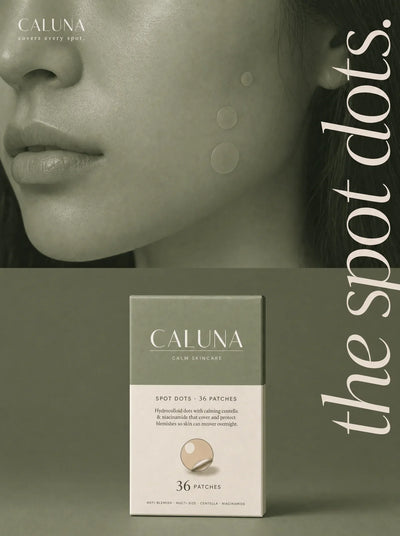
That's exactly the zone we built for. The Nose Patch is coming in November — join the nose list if a T-shaped patch made for the nose and its sides sounds like your problem area. (It's a simplified hydrocolloid formula, with the final ingredient list published at launch.) If you want something for a nose spot today, our Spot Dots are live — 36 invisible dots for $11.99, about 33¢ a dot.
When should I see a dermatologist?
If breakouts on your nose are persistent, painful, or just not settling down, that's a conversation for a dermatologist rather than a patch. A patch is for covering and protecting the odd spot — it isn't a substitute for real medical advice.
Race update: nose 3 · chin 1 · forehead 2 · kids 1.
The zone with the most names launches first on November 1st — pick yours.
— Jake, founder of Caluna.