
Yes — when a breakout spreads across your forehead instead of landing as one tidy spot, you can cover the whole band at once, and a single wide patch does it far better than scattering six little dots across your hairline. One continuous piece covers the spots and the sore skin between them, lifts in one go, and leaves your fingers nothing to pick at.
We're a little over two weeks out from Launch 2.0 on November 1st, and the forehead list is holding second in the zone race this morning — so a forehead question I get asked a lot feels like the right one to answer straight.
Can one patch really cover a whole forehead breakout?
Yes. When your bumps cluster in a band below the hairline rather than sitting as one lonely spot, a single wide hydrocolloid patch covers the whole stretch in one piece.
The forehead is a wide, mostly flat panel — which happens to make it the easiest zone on your face to cover with one piece. There's no steep curve like the nose or the jaw for an edge to peel off. A hydrocolloid patch is known for covering a surfaced spot, absorbing the fluid it gives off, and keeping your fingers off it — and across a cluster of spots, one patch does all of that over the whole area at once instead of spot by spot.

Why is one wide patch better than six little dots?
Because scattered dots leave bare gaps between them, lift at different times, and are fiddly to line up in a mirror. One continuous patch covers the spots and the skin between them as a single barrier.
Picture a bad forehead week: two spots that have surfaced, one coming up, and some red, tender skin between them. Six dots cover only the raised spots and leave the irritated skin in the gaps exposed — the exact skin your hand drifts to. A single piece covers the whole band as one, with far fewer edges to catch on a hat brim or a pillow and curl up.
Isn't dotting each spot cheaper?
Sometimes, but it's rarely tidier, and on a clustered breakout it often isn't even cheaper. By the time you've placed five or six dots and re-stuck the two that lifted, you've used more than you'd think.
The honest rule is to match the cover to the problem: a lone spot wants a single small dot, and a whole band of bumps wants one wide cover. Bigger only helps when there's genuinely more area to cover — hydrocolloid only draws fluid from the skin it's actually touching.
When do you not need a whole-forehead patch?
When you've got one or two spots with clear skin around them. A single dot on each is the whole job — there's no benefit to covering skin that isn't broken out.
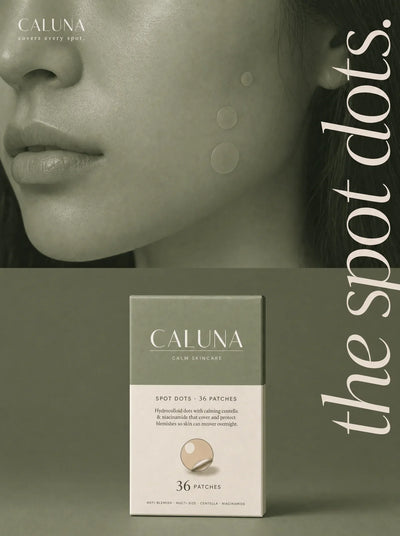
That everyday one-off spot is exactly what our Spot Dots are for right now — 36 invisible dots to a box at $11.99, about 33¢ a dot. Press one onto clean, dry skin and leave it 6 to 8 hours or overnight. Save the idea of a whole-zone cover for the weeks your forehead flares as a group.
How do you get a patch to actually stay on your forehead?
Start with clean, dry skin and press firmly for a good 10 to 15 seconds so the edges seal. The forehead's worst enemy for staying power isn't its shape — it's sweat and the oil it sits in.
I'm a gym guy and a Sunday runner, so I've learned this the slow way: a patch pressed onto a damp, just-worked-out forehead slides within the hour. Rinse and dry first, keep heavy moisturizer or sunscreen off the spot you're covering, and clip your bangs back off it. Do that and a patch will ride out a work shift or a night's sleep without you thinking about it.
When should you see a dermatologist?
If your forehead breakouts are deep, painful, cystic, or just won't settle no matter how clean you keep the skin, that's a conversation for a dermatologist rather than any patch.
One more thing worth knowing: small, itchy, look-alike bumps in a uniform spread across the forehead aren't always acne. They can be folliculitis — sometimes the fungal kind — which is a different situation that doesn't respond to the same moves. I'm a plumber, not a doctor, so take that as a nudge to get it looked at rather than as medical advice.
A patch built for exactly this panel of skin is coming: the Forehead Patch is coming in November — join the forehead list — one single wide patch that covers the whole band under your hairline instead of dotting six little circles across it. It's a simplified hydrocolloid formula, with the final ingredient list published at launch.
Race update: nose 3 · forehead 2 · chin 1 · kids 1.
The zone with the most names launches first on November 1st — pick yours.
— Jake, founder of Caluna.