

Yes — you can wear a pimple patch under makeup, but the order is everything. A hydrocolloid patch only sticks to clean, dry skin, so it has to go on before your foundation and concealer, never on top of a face you've already made up. Get that sequence right and a thin, invisible dot can all but disappear under the rest of your routine; get it backwards and the patch slides off by mid-morning.
Do pimple patches go on before or after makeup?
Before. A hydrocolloid patch grips clean, dry skin, so it should be the very first step — pressed onto a bare spot, not over foundation, concealer, or primer.
Here's why the order matters so much: hydrocolloid is an adhesive gel, and adhesive needs a clean surface to bond to. The moment there's a layer of makeup, oil, or moisturizer between the patch and your skin, the seal is compromised and the edges start lifting. So wash, dry the spot completely, press the patch on for a full 30 seconds, and only then move on to the rest of your face.

Can you put makeup over a pimple patch?
You can, but a patch works best with nothing layered directly on top of it. A thin, translucent dot is usually flat enough to leave bare, or to blur with a little concealer feathered around the edges rather than packed over the center.
Piling foundation straight onto a patch tends to backfire — makeup doesn't bond to the smooth gel surface the way it does to skin, so it pills, slides, and drags the edge up with every pass of a brush or sponge. The move that actually works is to do your makeup around the patch, treating it like a small no-go zone, then softening the border with a light touch if it's still catching your eye.
How do you make a pimple patch invisible under makeup?
Pick the thinnest, most translucent patch you can, size it close to the spot so there's barely any overhang, and apply it to clean skin before anything else. The less patch there is sitting proud of your face, the less there is to hide.
- Start bone-dry — skip moisturizer and SPF on the exact spot, since even a little slip breaks the seal.
- Choose a slim, near-clear hydrocolloid dot and match its size to the spot; a big dot on a tiny whitehead is mostly overhang.
- Apply first and press for a full 30 seconds so your skin's warmth softens the adhesive into place.
- Do your foundation and concealer around the patch, then feather just the edges with a light hand — don't rub the center.
- Set with a whisper of powder instead of piling another heavy layer on top.
Why won't my makeup stay put over a pimple patch?
Because foundation and concealer are made to bond with skin, not with a smooth sheet of hydrocolloid, so product tends to slide and ball up wherever it sits directly on the patch. That's normal, and it's not a sign you did anything wrong.
A patch is a slightly raised, non-porous surface, so it behaves nothing like the skin around it. Rather than fight it with more product — which only lifts the edges faster — it's easier to keep makeup off the patch itself and let the dot do its quiet work underneath. If you're reaching for a patch specifically so you can cover a spot for the day, a thinner, more invisible one is worth seeking out for exactly this reason.
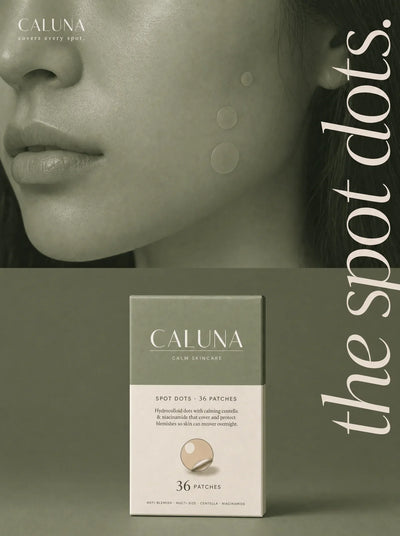
That "barely there under makeup" quality is the whole idea behind our Caluna Spot Dots — 36 invisible hydrocolloid dots a box, thin and translucent enough to wear bare or under a light layer, and built with seven skin-loving actives instead of the usual none. Seven actives. Most patches have zero. A patch like that is known for covering a raised spot, absorbing the fluid it weeps, and keeping your fingers off it — makeup or no makeup.
When should you skip the patch — or see a dermatologist?
Skip the patch on bare, unbroken skin — a hydrocolloid dot is made for a whitehead that has already come to the surface, not for a spot that's still deep and closed. Layering makeup over an empty patch just adds bulk with no benefit.
And remember a patch is a cosmetic cover, not a treatment — it doesn't cure or prevent acne. If your breakouts are deep, painful, cystic, or simply won't settle no matter what you change, that's a conversation for a dermatologist rather than another sticker and a fresh coat of concealer. Persistent acne responds best to a real plan from a professional.
— Jake, founder of Caluna.