
Yes — you can wear a pimple patch under makeup, as long as you do it in the right order: patch onto clean skin first, then makeup over the top. What you want to avoid is sticking a patch on over foundation, because it won't grip and it won't absorb. Here's how to get an invisible dot to disappear under concealer and actually stay put through the day.
Can you wear a pimple patch under makeup?
Yes. A thin, translucent hydrocolloid patch can sit under foundation and concealer — the trick is to apply it to clean, dry skin first and build your makeup over it, not the other way around.
Hydrocolloid dots are deliberately thin and semi-clear, so a well-placed one nearly vanishes once a light layer of base goes over it. The smoother and flatter the patch, the better it hides. A thick, bright-white patch will always show; a slim, tapered one is the kind people genuinely wear to work without anyone noticing.
Can you put a pimple patch on top of makeup?
No — that's the one order that doesn't work. A hydrocolloid patch needs to stick directly to clean skin to grip properly and to absorb fluid from the spot, and a layer of foundation or powder underneath blocks both.
Put a patch over makeup and two things happen: it slides off within an hour because it's clinging to slippery product rather than skin, and it can't draw up any of the fluid from a whitehead because there's a film in the way. If you realize you need a patch after you've already done your face, gently clean just that one spot, let it dry, press the patch on, then touch the area back up.

How do you apply makeup over a pimple patch?
Keep it light, and press rather than drag. The goal is to cover the edges of the patch without wiping it off, so dab product on top instead of sweeping a brush across it.
- Start on clean, dry skin. Press the patch down firmly for a few seconds so the edges seal flat before you touch anything else.
- Do the rest of your routine normally, but go gently right over the patch — a thin layer of moisturizer and sunscreen first, well away from the dot if you can.
- Apply foundation around the spot, then dab a little over the patch with a fingertip or a damp sponge, pressing straight down.
- Spot-conceal the patch's edges with a small brush, blending outward onto the skin, not back and forth across the patch.
- Set it with a light touch of powder pressed on. Avoid buffing or wiping, which is what lifts an edge.
Which pimple patches disappear best under makeup?
The thinnest, most translucent ones with tapered edges. A flat, nearly invisible dot blends under base far better than a thick, opaque patch that casts its own little shadow.
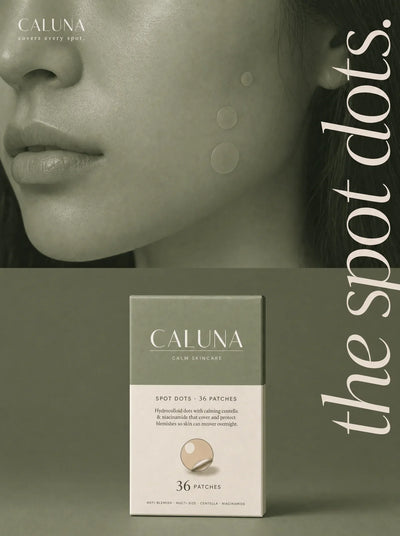
This is where it's worth reading the patch itself. Our Caluna hydrocolloid patches are made to be nearly invisible — 36 dots a box, about 33¢ each — and they carry 7 skin-loving actives where most patches have zero: hydrocolloid, tea tree oil, salicylic acid, centella asiatica, calendula, niacinamide and hyaluronic acid. The hydrocolloid covers the spot, absorbs fluid and keeps your fingers off it, while salicylic acid is known for helping pores feel clearer and centella and hyaluronic acid are known for keeping the skin underneath feeling calm rather than stripped — which matters when you're about to layer makeup on top.
Is it better to just wear the patch at night instead?
Often, yes. If you don't strictly need makeup that day, a fresh patch worn for six to eight hours or overnight on bare skin does its job with nothing in the way.
Makeup and a patch can coexist for a workday or an event, but a hydrocolloid dot works most comfortably on clean skin with no foundation competing for the same spot. A common rhythm: wear a discreet patch under makeup through the day, then take everything off at night, cleanse, and put a fresh patch on the spot before bed so it has uninterrupted time to settle.
Does makeup over a patch slow it down?
A light layer applied gently is fine. The patch underneath still covers the spot and absorbs fluid as usual, as long as you didn't smother it or wipe it loose putting the makeup on.
The thing that actually sets a spot back isn't a dab of concealer — it's picking at it, and a patch quietly solves that by putting a barrier between your fingers and the pimple all day. If an edge lifts or the patch has clouded over from absorbing fluid, swap in a fresh one rather than pressing the old one back down.
When should you see a dermatologist?
If your breakouts are severe, painful, cystic, or simply won't let up, a dermatologist is the right call — patches and makeup are for everyday spots, not a substitute for medical care.
Covering a surface whitehead so you can get through a meeting is exactly what a patch is for. A spot that stays deep, sore, and stubborn for weeks no matter what you do is a different problem, and there's no prize for toughing that one out alone. I make cosmetic patches, not medicine, so I'll always say that part plainly.
— Jake, founder of Caluna.