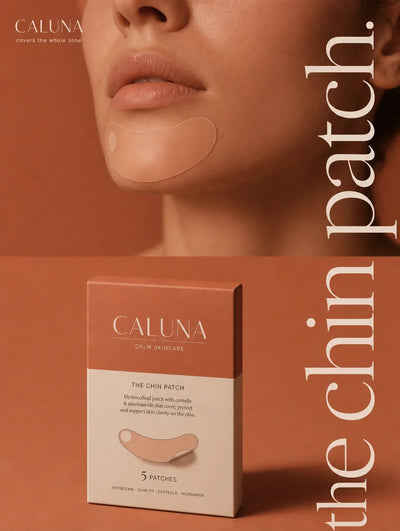

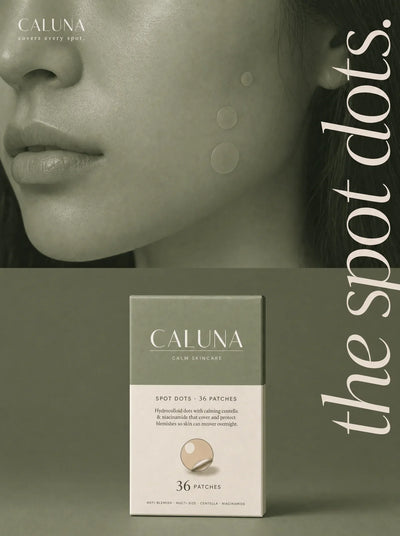

It's October 2nd — about four weeks out from Launch 2.0 on November 1st — and here's a question that lands in my inbox every time somebody's forehead flares up across a whole stretch at once: do you dot six little patches across it, or reach for one wide one? If the breakout is spread over an area, one wide patch almost always wins. It covers the whole zone in a single piece, sits flatter under a hat, and won't lift at the edges the way a row of small dots does.
Should you use one wide patch or several small dots on your forehead?
For a breakout spread across an area, use one wide patch. For one or two isolated spots with clear skin between them, individual dots are fine — it comes down to how much ground you're trying to cover.
Forehead breakouts tend to show up in clusters rather than as one lone spot: a little band of bumps along the hairline, or a scatter between the brows. Dotting each one means six seams, six edges, and six chances for one to catch on a hat brim and roll off by lunch. A single piece has one edge the whole way around, so there's far less for friction to grab.

Why do small patches peel off the forehead so easily?
Because the forehead takes constant friction and sweat — hats, headbands, hair, your hand pushing your hair back — and every small patch carries its own edge for that friction to lift.
Hydrocolloid grips by sealing flat against the skin, and the edge is always the weak point. On a high-movement, often-sweaty surface like the forehead, more patches mean more edges, which means more places to start peeling. A wide patch spreads its hold over a bigger footprint, so there's proportionally less edge for the amount of skin it's covering. I'm a gym guy and a Sunday runner, so trust me: a row of dots and a sweatband are not friends.
Does a wide patch actually do anything different than a dot?
Mechanically, no — it's the same hydrocolloid doing the same job: covering the spot, drawing up fluid, and keeping your fingers off it. The difference is how much it covers and how long it stays put.
Hydrocolloid is known for absorbing the fluid from a popped or weepy whitehead and forming a soft gel seal over it while it works. One patch or twelve, that part is identical. What a wide patch buys you on the forehead is that it keeps doing it across the whole area with no gaps between dots where a bump sits uncovered and tempting to pick at.
When are individual dots still the better call?
When you've got one or two spots with healthy skin between them. Covering each one beats slapping a big patch over clear skin for no reason.
You don't need to cover ground that isn't broken out. For a single whitehead on the forehead — or anywhere — a dot that just covers the spot is less visible and less wasteful. It's genuinely a size-of-the-problem decision, not a better-or-worse one.
How do you make any forehead patch last longer?
Put it on clean, fully dry skin and press it down for a solid ten seconds. The two things that kill a forehead patch are oil and moisture under the edge, so apply it after your shower, not before a workout, and give your skin a minute to dry first.
One more honest note: a pimple patch covers and protects a spot — it isn't a fix for a forehead that's broken out for weeks, or for bumps that are painful or spreading. If that's you, especially if the bumps are small, uniform and itchy (people online love to call that "fungal acne"), it's worth a dermatologist's eyes rather than a guess from a patch.
So which one should you keep on hand?
Both, honestly. For scattered everyday spots, the Caluna Spot Dots are what I can actually put in your hands today — 36 invisible dots a box. For a breakout that sprawls across your whole forehead, a single wide band is the better tool, and that's exactly what the Forehead Patch is built to be — one piece, one edge, whole zone. It's coming in November — join the forehead list (it uses a simplified hydrocolloid formula, with the final ingredient list published at launch).
Race update: nose 3 · chin 1 · forehead 1 · kids 1. The zone with the most names launches first on November 1st — pick yours.
— Jake, founder of Caluna.