

It's Friday, September 4th — the first public scoreboard day for our zone race, and with about eight weeks to go until the November 1st launch, the nose list is out front. Fitting, then, to answer a nose question I get constantly from anyone who wears glasses: do your frames actually break you out? Short version — glasses don't cause acne on their own, but the pressure, trapped oil, and sweat where the nose pads and bridge sit can absolutely push a breakout-prone nose over the edge. If your spots line up exactly where your frames rest, your glasses are worth a second look.
Do glasses cause breakouts on your nose?
Not by themselves. What triggers the breakouts is the friction and pressure of frames sitting in one spot for hours, plus the oil and sweat that get trapped under the nose pads.
Dermatologists have a name for the friction-and-pressure kind of breakout: acne mechanica. Glasses are a textbook cause of it — they press the same two points on your nose all day, every day, and the nose is already one of the oiliest parts of the face. Sunglasses in the Florida sun where I live are worse, because you add sweat to the mix.

Why does the nose break out under glasses?
Because the nose runs oily to begin with, and frames trap that oil against the skin. The nose sits in the middle of your T-zone, where oil glands are packed densest, so any surface pressed against it holds sebum, sweat, and bacteria right where pores can clog.
Nose pads make it worse by concentrating all of that onto two tiny contact points. Add a warm day, a run, or a long stretch at a screen, and those little pads become warm, damp, rubbing spots — exactly the conditions breakouts like.
Are the red marks from my glasses acne or just pressure?
Sometimes it's neither. Glasses commonly leave harmless pressure dents and temporary red marks that fade within an hour of taking them off — that's not a breakout, just your skin bouncing back.
An actual breakout shows up as a raised bump or whitehead that sticks around, right where the pads sit. If the marks vanish quickly, it's pressure; if they linger and come to a head, it's more likely a spot. Either way, painful or stubborn breakouts are worth a dermatologist's eyes rather than guesswork — I'm a plumber who makes patches, not a doctor.
How do you stop your glasses from breaking out your nose?
Keep the contact points clean and cut down how long oil and sweat sit there. Small habits do most of the work.
- Wipe your nose pads down a few times a week — they collect oil and makeup you never notice.
- Clean your nose after a workout or a sweaty afternoon instead of letting your glasses press sweat back in.
- Make sure your frames actually fit — pads digging in from too-tight glasses mean more pressure on one spot, and most opticians will adjust them in a couple of minutes.
- Give your nose some open air when you can, especially if you switch between regular glasses and sunglasses all day.
None of this is a cure — it's just removing the little insults so your skin gets a real break between them.
What actually helps a spot right where your glasses sit?
Once a spot has come to a head, cover it and leave it alone. A hydrocolloid patch is known for sealing over the spot, absorbing the fluid it leaks, and keeping your fingers — and your frames — off it while the skin settles.
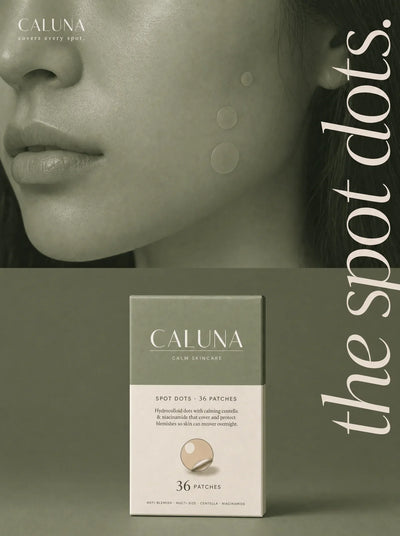
The tricky part on the nose is that a flat round dot doesn't love a curved, sloping surface, and glasses drag at its edges. Our Spot Dots cover a single spot on a flatter stretch of nose well enough for now. But the nose is exactly why we're building a patch shaped for it: The Nose Patch is a single T-shaped patch that covers the bridge and the sides of the nose in one piece, in a dusty-blue color world, priced at $12.99. It's a simplified hydrocolloid formula — final ingredient list published at launch — and it's not for sale yet. It's coming in November — join the nose list.
Race update: nose 3 · chin 1 · forehead 1 · kids 1. Small numbers, real numbers — that's the point of doing this in the open.
The zone with the most names launches first on November 1st — pick yours.
— Jake, founder of Caluna.