
We're about eight weeks out from Caluna's November 1 launch, and the first public zone-race scoreboard drops this Friday — so let me answer a question I get a lot from the gym crowd: yes, the stuff you put in your hair is often a bigger driver of forehead breakouts than anything you put on your face. Dermatologists even have a name for it — pomade acne — and it clusters exactly where your product meets your skin.
Can hair products cause forehead breakouts?
Yes, they can — heavy, waxy hair products migrate down to the hairline and forehead and clog the pores there. It's common enough that dermatologists have a term for it: pomade acne (or acne cosmetica), named for the greasy pomades that first made it a thing.
Sweat, heat, and a hat push those ingredients deeper into the skin, which is why a lot of people notice it worst along the hairline and in a band right under where their cap sits. If your breakouts live in a neat row across the top of your forehead, your hair routine is the first place I'd look.

What exactly is "pomade acne"?
Pomade acne is clogged pores caused by oily or waxy hair products sitting against the skin. The pores get blocked, and you get small bumps and whiteheads concentrated at the hairline and forehead rather than scattered everywhere.
It usually looks like a cluster of uniform little bumps — not the occasional deep one — and it tends to hug the edges where your hairline, sideburns, or the back of your neck meet your product.
Which hair products are the usual culprits?
The heavy, occlusive ones. Anything designed to coat the hair and hold a style tends to be the worst offender for the skin it touches.
- Pomades, waxes, and thick styling creams
- Oils and leave-in conditioners that run when you sweat
- Gels and hairsprays that drift onto the forehead
- Some dry shampoos that build up along the hairline
None of these are "bad" — I use a couple of them. The problem is contact time and heat, not the product existing.
How do you keep your hairline clear without ditching your products?
Keep the product off the skin and clean the border. You don't have to give up your hair routine — you just have to manage where it lands and how long it sits.
What actually helps: apply styling product a finger-width away from your hairline instead of right at the edge; wash your forehead and hairline at night, not just your hair; and after a sweaty workout, run a cleanser along the hairline before the sweat-and-product mix dries back into the skin. If you wear a hat or headband, let your product fully dry first and give the band a wash now and then — a damp, greasy band is basically a press applying your gel to your forehead all day.
Could forehead bumps be something other than clogged pores?
Sometimes, yes. A tight field of small, itchy, same-size bumps along the hairline can be folliculitis or so-called "fungal acne" (malassezia), which is inflammation around the hair follicle rather than a classic clogged pore — and it doesn't respond to the same routine. If your forehead bumps are persistent, itchy, or painful, that's a dermatologist visit, not a guessing game.
Where a patch fits in
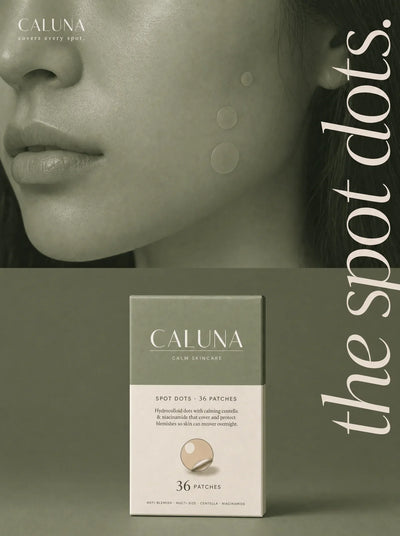
A patch won't fix your hair routine, but it earns its keep on the spot that already came up. When a forehead bump comes to a head, our Spot Dots (available now) cover it and absorb the fluid overnight so you keep your fingers off it while you sort out the hairline habits above.
The reason I'm building a dedicated forehead version is that dotting six little circles across your forehead looks ridiculous — so The Forehead Patch is one wide hydrocolloid strip that sits across the zone instead. It's a simplified hydrocolloid formula, with the final ingredient list published at launch. It's coming in November — join the forehead list.
Race update: nose 3 · chin 1 · forehead 1 · kids 1. The zone with the most names launches first on November 1st — pick yours.
— Jake, founder of Caluna.