
We're about three weeks out from November 1, and the nose list is still out front in the zone race this morning — but this one's for the foreheads. If your sunscreen seems to break you out up top, here's the honest answer: sometimes it does, but more often it's the sunscreen plus a sweaty hairline plus a hat pressing it in for hours. The fix is almost never "stop wearing sunscreen."
Can sunscreen actually cause forehead breakouts?
Yes, it can. A heavy or greasy formula can sit in your pores and trap oil, and the forehead is one of the oiliest zones on your face, so it feels it first.
But "can" isn't "always." Plenty of us blame the sunscreen when the real story is how it's getting worn: layered on thick, trapped under a cap, carried through a two-hour run, and then left on overnight. Same tube, very different outcome.
Why does it show up on the forehead first?
Because the forehead is a dense band of oil glands sitting right under your hairline and your hat line. Sunscreen that never fully absorbs mixes with sweat and whatever's in your hair and collects along that top strip.
That's exactly where a cap brim or a headband presses it in. Friction plus a covered, sweaty surface is why the forehead and temples tend to flare before your cheeks ever do.

Which sunscreens are more likely to clog?
As a rough rule, the thicker and greasier a sunscreen feels going on, the more likely it is to sit on oily skin instead of sinking in. If your forehead runs oily, lighter gel and fluid textures, or anything labeled "non-comedogenic," usually behave better than rich creams.
That label isn't a promise — skin is personal, and a formula that clogs your friend might be fine on you — but it's a sensible place to start if you're reaching for a new tube.
So should I skip sunscreen to stop breaking out?
No. I say that as a guy who runs Sunday mornings in Florida sun — trading sun protection for a few fewer bumps is a bad deal. The better move is to change the formula or the routine, not drop the protection.
Sunscreen or sweat — which one is really doing it?
Usually both, working together. Sweat on its own rarely breaks you out; sweat sealed under sunscreen and a hat for hours is a different situation.
A few small habits take most of the pressure off your forehead:
- Let sunscreen absorb for a few minutes before a hat or headband goes on.
- Blot or rinse your forehead after a sweaty workout instead of reapplying straight over dried sweat.
- Wash it all off at the end of the day so nothing sits on your skin overnight.
- Keep whatever you apply it with clean, and rotate a sweaty cap or band instead of grabbing the same damp one daily.
What if a spot pops up anyway?
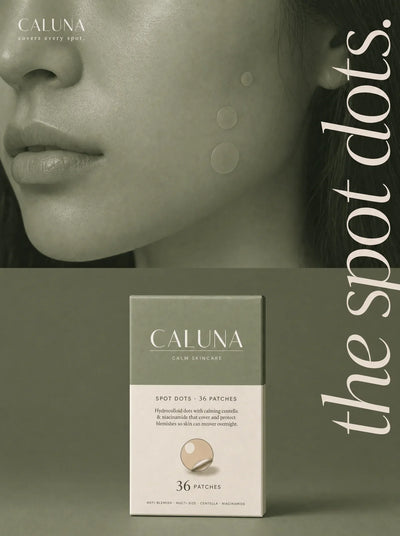
Cover it and keep your fingers off it. A hydrocolloid patch is known for drawing the fluid out of a popped or weepy spot and giving it a clean, protected surface to settle under while your hands stay busy elsewhere. Our Spot Dots are built for exactly that on a single spot — and a wide Forehead Patch, a simplified hydrocolloid formula with the final ingredient list published at launch, is coming in November, so you can join the forehead list.
When should I see a dermatologist?
If the breakouts are persistent, painful, or showing up as a cluster of small, uniform bumps, it's worth getting a professional look. That last pattern can point to folliculitis — what people online often call "fungal acne" — which doesn't respond to the same things regular breakouts do, and a dermatologist can tell the difference far better than a mirror can.
Race update: nose 3 · chin 1 · forehead 2 · kids 1. The zone with the most names launches first on November 1st — pick yours.
— Jake, founder of Caluna.