
Quick note before the skincare: we're two weeks out from Launch 2.0 on November 1st, and the nose list is out front. Now the question I actually get asked every October — can you do anything about a red pimple on your nose before a big day? You can't make it vanish overnight, and no honest brand should promise that. But you can keep it from getting angrier, and you can cover it well enough that nobody at the wedding, the photo, or the first date is looking at it.
Why does a pimple on your nose turn so red?
The nose sits dead center on your face, the skin there is thin, and it's one of the oiliest patches you've got — so the same bump that would barely register on your cheek shows up redder and more obvious on your nose.
Two things stack up here. The nose and the rest of the T-zone are packed with oil glands, which is why spots like to set up there in the first place. And because the skin over the nose is thin with blood vessels close to the surface, any inflammation reads as a brighter, angrier red. It's not that your nose spot is worse than a cheek spot — it's just in the worst possible spot to hide.

What should you not do the night before an event?
Don't pop it, don't scrub it, and don't throw three brand-new products at it. The night before a big day is the worst time to experiment.
- Don't squeeze. Popping a nose spot almost always trades a red bump for a red, raw, scabbing mess — and that's much harder to cover with makeup.
- Don't over-scrub. Scrubbing an oily nose to "dry it out" strips the surface and usually leaves it more irritated, not less.
- Don't pile on new actives. A strong acid or retinoid you've never used before can leave your nose flaky and tight by morning. Stick to what your skin already knows.
What actually helps calm a red nose spot?
The honest list is short: keep your fingers off it, cover it with a hydrocolloid patch overnight, and use a brief cool compress if it's puffy. None of that is a cure — it's damage control that lets the spot settle on its own.
Hydrocolloid is the gel material you'll see in most pimple patches. It's known for absorbing fluid from a spot that's come to a head and sealing it off from your fingers, your pillow, and the air. That "hands-off" part matters more than people think — a nose spot you leave alone overnight almost always looks calmer in the morning than one you kept touching. A couple of minutes with a cool, clean compress can take some of the puffiness down too. Nothing dramatic, but it helps.
Can you cover it and still look like yourself?
Yes. A thin, translucent hydrocolloid patch can sit under makeup, or you can wear one overnight and conceal in the morning once it's flatter.
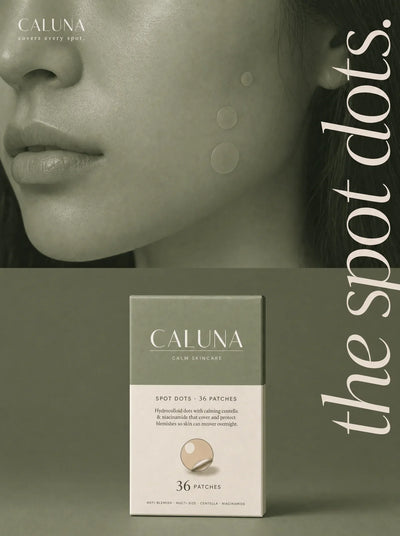
This is the one place a product fits in honestly: our Spot Dots are available now — invisible hydrocolloid dots that cover a spot, protect it, and keep your fingers off it, at about 33¢ a dot. On the nose specifically, a smaller dot pressed firmly on clean, dry skin behaves best. For a big flat area or the curve of the nostril, dots can lift at the edges — which is the exact problem the zone patches are built to fix.
What about a patch actually shaped for the nose?
A flat round dot doesn't love a curved surface. The Nose Patch — a single T-shaped patch that covers the nose and the sides of it, in a simplified hydrocolloid formula with the final ingredient list published at launch — is coming in November, so join the nose list. It's in our dusty-blue world and it's built for exactly the terrain a dot struggles with.
When should you stop DIY-ing it?
If a nose spot is genuinely painful, keeps coming back in the same place, or is a deep lump that never surfaces, that's a dermatologist conversation, not a patch. Patches cover and protect — they don't treat what's happening underneath, and a doctor can actually help with the recurring stuff.
Race update: nose 3 · chin 1 · forehead 2 · kids 1.
The zone with the most names launches first on November 1st — pick yours.
— Jake, founder of Caluna.