
Short answer: no — you don’t need to dry out a pimple, and trying to often leaves your skin redder, flakier, and more tempting to pick than when you started. Spots tend to settle down faster in a lightly moist, protected environment than under layers of alcohol, toothpaste, or whatever else promises to “zap” them overnight. Here’s what’s really happening when a blemish looks like it’s drying up, and what to reach for instead.
Should you dry out a pimple?
No. Drying out a pimple isn’t the goal, and it usually makes the skin around it worse. Harsh drying agents strip the surrounding skin, leaving a dry, flaky patch that can be more noticeable than the spot itself — and irritated skin stings, peels, and practically begs to be picked. What you actually want is for the area to feel calmer and less angry, and that rarely comes from stripping it.
Why does “drying it out” feel like it works?
Because a blemish shrinking and flattening is mostly your skin quieting down on its own — not the drying agent doing the work. When you dab on something harsh, the redness that follows is often irritation, and the flakiness can look like the pimple “surfacing” when it’s really just dried skin. The spot may have calmed anyway. The drying step just takes credit for timing it never controlled.

What actually helps a pimple calm down faster?
Keeping your hands off it, keeping the area clean and lightly hydrated, and covering it so you’re not touching or picking. Gentle beats aggressive almost every time. A few things that genuinely help:
- Leave it alone. Squeezing and picking push fluid and bacteria deeper and can turn a two-day spot into a two-week mark.
- Cleanse gently, don’t scrub. A mild cleanser once or twice a day is plenty; scrubbing an active breakout just piles on irritation.
- Skip the DIY “zappers.” Toothpaste, lemon juice, rubbing alcohol, and baking soda are harsh on skin and don’t belong on a blemish.
- Cover it. A physical barrier keeps your fingers out and lets the area sit undisturbed.
Do pimple patches dry out a pimple?
Not exactly. A hydrocolloid patch absorbs fluid from a spot that has already come to a head while keeping the skin around it covered and comfortable, rather than parching it — the opposite of the crackly, tight feeling you get from alcohol-based spot treatments.
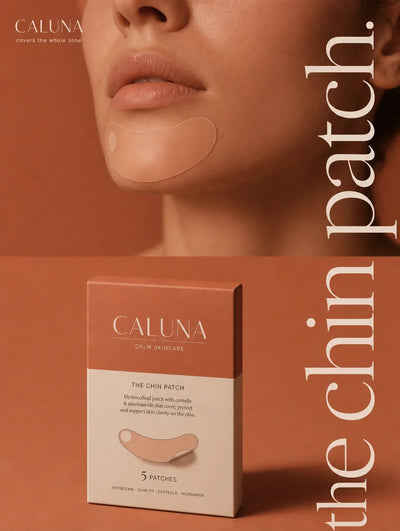
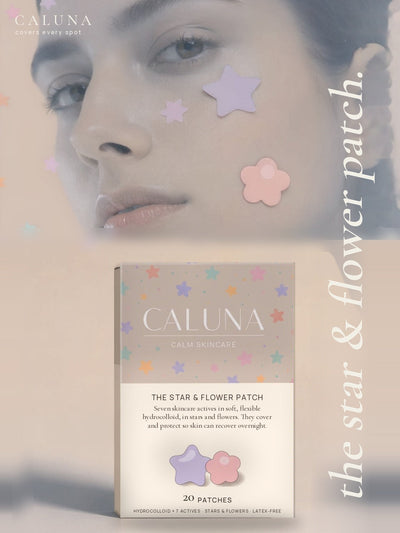
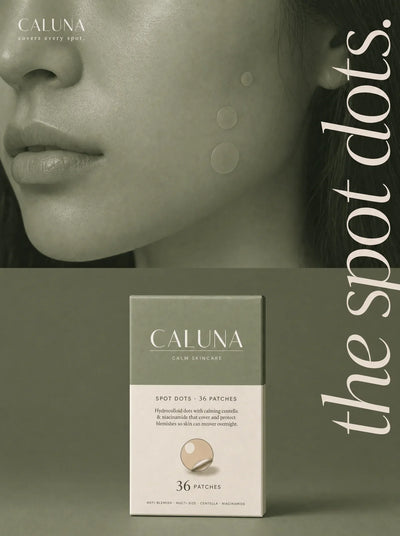
That’s the case for hydrocolloid specifically: the gel draws out excess fluid and gunk, helping flatten a whitehead, while the patch shields it from your fingers and outside grime. Some patches go further with added ingredients. Caluna Hydrocolloid Pimple Patches pack in seven skin-loving actives — hydrocolloid, tea tree oil, salicylic acid (known for keeping pores feeling clear), centella asiatica, calendula, niacinamide, and hyaluronic acid to keep the skin around a spot hydrated instead of stripped. Most patches have zero actives; these have seven. You get 36 invisible patches per box, so there’s always one on hand when a spot shows up.
When should you see a dermatologist?
If your breakouts are deep, painful, widespread, or simply won’t let up, that’s worth a conversation with a dermatologist rather than more home experiments. Patches and gentle care are great for the occasional surface spot, but persistent or cystic acne may need professional guidance and prescription options a patch can’t offer. There’s no prize for toughing it out alone.
— Jake, founder of Caluna.