
Tea tree oil is a plant-derived essential oil that skincare fans have leaned on for decades, and the short version is this: it's best known for helping breakout-prone skin look less red and feel calmer, not for "curing" anything. Pressed from the leaves of the Australian Melaleuca alternifolia tree, it turns up in cleansers, spot gels, and patches because a very little goes a long way. Here's what it actually does, where it helps, and how to use it without irritating your skin.
What is tea tree oil, and what is it known for?
Tea tree oil is an essential oil steam-distilled from the leaves of the tea tree, a plant native to Australia. In skincare it's known for a clarifying, soothing reputation — the sense that skin looks a little calmer and clearer after it's used.
It has been used on skin for a long time, and its main compound, terpinen-4-ol, is the part most associated with that fresh, purifying feel. You'll almost always find it diluted — rarely more than about 5% in a finished product — because in its pure form it is extremely concentrated.
Does tea tree oil help with breakouts?
It can help a spot look and feel less angry. Tea tree oil is known for keeping skin feeling clearer and calmer, which is why it has been a go-to for breakout-prone skin for years.
The honest caveat: results vary from person to person, and tea tree oil works best as one small part of a simple routine rather than a miracle fix. It sits naturally alongside gentle cleansing and not over-touching the area. If a spot is deep, painful, or sticks around for weeks, that's a signal to see a dermatologist rather than layering on more oil.

Is tea tree oil better than salicylic acid?
Neither is "better" — they do different jobs, and they're often used together. Salicylic acid is known for helping keep pores feeling clear, while tea tree oil is known for a calming, clarifying feel on the surface of the skin.
It helps to think of them as a team rather than a competition. Plenty of well-made products combine a gentle exfoliating acid with soothing botanicals so you get both effects in one step, without doubling up on two separate harsh treatments. That's usually kinder to your skin barrier than piling one strong product on top of another.
Can you put tea tree oil straight on a pimple?
You shouldn't use it undiluted. Pure tea tree oil is very strong and can leave skin stinging, red, or dry, so it should always be diluted in a carrier oil or used in a product already formulated at a safe level.
If you're working with a pure oil at home, the usual guidance is to dilute it heavily — often a drop or two in a teaspoon of a carrier such as jojoba — and to patch-test on a small area of skin first. Anyone pregnant, or with very sensitive or eczema-prone skin, should check with a professional before trying it, and keep it well away from your eyes.
How does Caluna use tea tree oil?
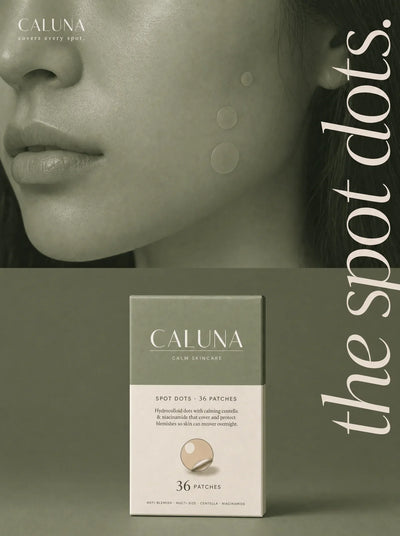
We build it into the patch itself, at a gentle level, so you never have to handle the raw oil. Tea tree is one of the seven skin-loving actives in a Caluna Hydrocolloid Pimple Patch — alongside hydrocolloid, salicylic acid, centella asiatica, calendula, niacinamide, and hyaluronic acid. Most patches have zero actives; ours have seven.
The hydrocolloid covers the spot and absorbs fluid while the dot stays put overnight, and the botanicals sit against the skin the whole time. A box is 36 invisible patches for $11.99 — about 33¢ a dot — with free US shipping, and your first box is $6.99 with code FIRSTBOX if you want to try it. Covering a spot also does one quiet, underrated thing: it stops you picking at it.
The takeaway
Tea tree oil is a gentle, plant-derived ingredient known for helping breakout-prone skin look less red and feel calmer. It isn't a cure, it works best diluted and as part of a simple routine, and it plays well with other actives like salicylic acid. For a stubborn or painful breakout, a dermatologist is still your best call.
— Jake, founder of Caluna