
Your chin breaks out more than your cheeks because the skin along your lower face and jaw carries more oil glands, and reacts more strongly to your natural hormone swings, than your cheeks do. Add the fact that your chin is the part of your face your hands, phone and pillow touch all day, and you get a zone practically built for clustered breakouts.
It's late September as I write this — a little over five weeks out from our November 1st Launch 2.0 — and the chin is the exact zone this whole journal exists for. So here's the honest breakdown.
Why does your chin break out more than your cheeks?
Two things stack up: your jaw and chin have a higher density of oil glands than your cheeks, and the skin there responds more strongly to your natural hormone swings. More oil plus more reactive skin means more clogged pores in the same square inch.
Your cheeks are broad and flat, with glands spread thinner, so a stray spot there tends to stay a stray spot. The chin and jaw pack their glands closer together, which is why a breakout there so often shows up as a little group rather than one lonely bump.
What is the "U-zone," and why does acne cluster there?
The U-zone is the curve that runs from in front of your ears, down along the jaw, and across the chin. It's the lower-face counterpart to the oily T-zone, and it's where adult, hormonal-pattern breakouts most often set up shop.
If your teenage breakouts lived on your forehead and nose but your grown-up ones moved south to the jaw, you're not imagining it — that shift toward the U-zone is one of the most common patterns people describe to me.

Does touching your chin make breakouts worse?
It can. Resting your chin in your hand, pressing a phone to your jaw, or sleeping on a few-days-old pillowcase all add friction and transfer to a zone that's already prone to congestion.
None of that is the root cause — the oil glands and hormones are — but contact is the part you can actually change today. Keep your hands off, wipe your phone screen, and flip to a fresh pillowcase a couple of times a week.
What actually helps a chin breakout?
Keep the area clean and low-friction, leave spots alone instead of picking, and cover an active whitehead so your fingers stay off it while it settles. That's most of the battle, honestly.
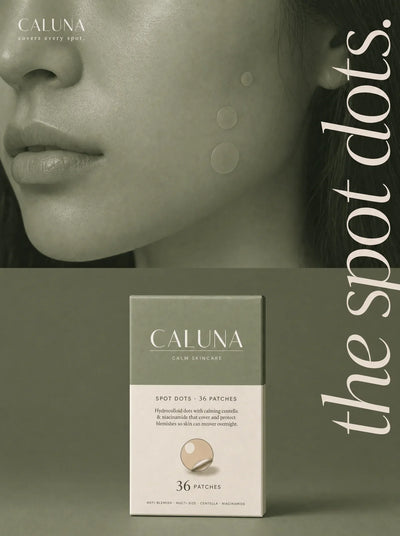
A gentle cleanse after you sweat, a clean pillowcase and hands-off patience do more than any single product. When a whitehead has come to a head, a hydrocolloid patch is known for absorbing the fluid and keeping the spot covered so the skin can feel calmer — our Spot Dots are 36 invisible dots a box for exactly that job, available now. If your chin breaks out in deep, painful bumps that never surface, that's worth a conversation with a dermatologist rather than a patch.
Does covering the whole chin work better than dotting one spot?
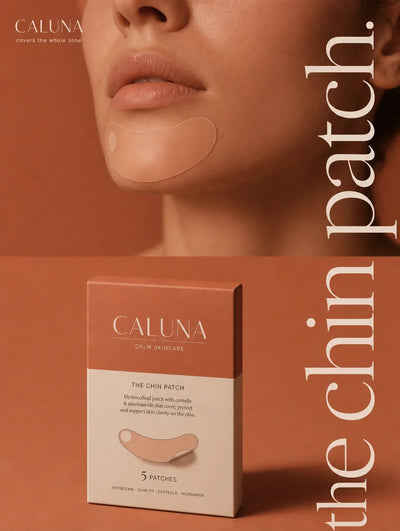
When your breakouts show up as a cluster instead of a single spot, a patch shaped to the whole area covers the group and the skin between them at once — no gaps, and no chasing each bump with a separate dot.
That's the idea we're building toward for the lower face: one crescent-shaped hydrocolloid patch that follows the chin and jawline where U-zone congestion tends to live. It runs a simplified hydrocolloid formula — final ingredient list published at launch. The Chin Patch is coming in November — join the chin list if that's your zone.
Race update: nose 3 · chin 1 · forehead 1 · kids 1. The zone with the most names launches first on November 1st — pick yours.
— Jake, founder of Caluna