

We're a little over two weeks out from Launch 2.0 on November 1st, and this morning the nose list is still leading the zone race — so a nose question feels right. Why is your nose the oiliest part of your face? Because it sits in the middle of your T-zone, where your skin carries the highest density of sebaceous (oil) glands anywhere on your face — more glands packed into that small patch means more oil, and more of the clogged pores and blackheads that come with it.
Why does my nose make so much more oil than my cheeks?
Because it has far more oil glands packed into it. The nose and the central T-zone carry a much higher density of sebaceous glands than your cheeks or the outer edges of your face.
Those glands produce sebum, the oil that keeps skin from drying out. On your cheeks they're spread thin; on your nose they're concentrated. Same person, same day — the nose just has more taps open. That's why the shine shows up there first a few hours after you wash, and why the pores look bigger: a busier gland tends to sit under a wider pore opening.

What does all that oil actually do to my pores?
It mixes with dead skin cells and fills the pore. When that mix reaches the surface and meets air, it darkens — which is what most people are seeing when they talk about “nose blackheads.”
Worth knowing: a lot of what shows up on the nose isn't a true blackhead at all. Those tiny, evenly spaced gray dots down the sides of the nose are usually sebaceous filaments — the normal way a full oil gland lines its pore. They come back because they're meant to be there. A real blackhead is a single clogged pore that stands out from that even pattern. This is educational, not a diagnosis — and no patch, strip or scrub “removes” either one for good.
Can I stop my nose from being oily?
Not really — and chasing that is where most people make it worse. How many oil glands you have, and how active they are, comes down mostly to genetics, hormones and age, not to a product that resets them.
The move is to manage the oil, not wage war on it. When you strip the nose with harsh cleansers or scrub it raw, skin often answers by making more oil, and you've traded shine for irritation on top of the shine. Gentle wins here.
So what actually helps an oily, breakout-prone nose?
Keep it simple: a gentle cleanser twice a day, skip the over-scrubbing, choose non-comedogenic sunscreen and moisturizer, and keep your fingers off it between washes. When a spot does surface and come to a head, that's when a patch earns its place.
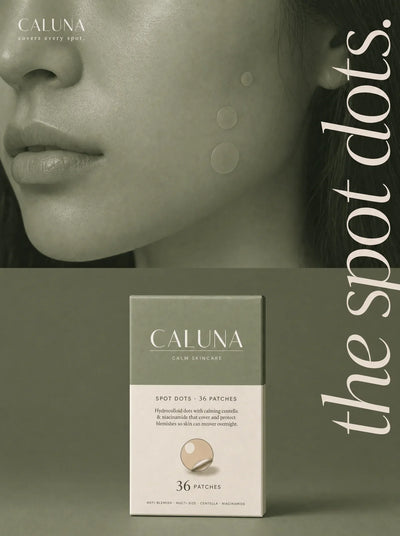
A Caluna hydrocolloid Spot Dot is known for covering a spot that's surfaced on the nose, absorbing the fluid it gives off, and — maybe most useful on a zone you touch all day — keeping your fingers off it while it settles. If your nose stays painful, cystic, or breaks out no matter what you try, that's a dermatologist conversation, not a patch one.
Why won't a round dot stay on the curve of the nose?
Here's the honest catch, and it's the reason we're building what we're building: a flat round dot fights the slope where the nose meets the cheek, and the sides of the nose are exactly where the oily-pore trouble tends to cluster. That's what The Nose Patch, coming in November — join the nose list, is shaped for: a single piece that follows the nose and its sides instead of peeling at the edge. It's a simplified hydrocolloid formula, with the final ingredient list published at launch.
Race update: nose 3 · chin 1 · forehead 2 · kids 1. The zone with the most names launches first on November 1st — pick yours.
— Jake, founder of Caluna.