 Liquid error (snippets/caluna-cart-extras line 104): invalid url input
We're about seven weeks out from Caluna's November 1st launch, and the question I keep getting from people whose breakouts live on the nose is a simple one: why is it always the nose? The short version is that your nose sits at the center of the T-zone, the part of your face with the highest concentration of oil glands, so it produces more sebum than almost anywhere else on your skin. More oil means more chances for a pore to get congested — which is why the nose so often feels shiny by noon and breaks out more than your cheeks.
Why is the nose the oiliest part of your face?
Because it has more oil glands packed into less space than the rest of your face. Sebaceous glands aren't spread evenly across your skin — they cluster heavily around the nose, the center of the forehead, and the chin, and thin out toward the edges of your face.
Estimates put the gland density in the T-zone far higher than on the cheeks: the nose and forehead can carry several hundred oil glands per square centimeter, while your cheeks carry a fraction of that. Add in the fact that the nose has plenty of little creases and folds where oil and dead skin can collect, and you get the shiniest, most breakout-prone real estate on the whole face.

What actually is the "T-zone"?
It's the strip of skin that runs across your forehead and straight down your nose to your chin, roughly shaped like the letter T. It gets its own name because it behaves differently from the rest of your face — oilier, shinier, and more prone to congestion.
This is also why a lot of people are technically "combination" skin without ever realizing it: an oily T-zone paired with normal-to-dry cheeks. One-size routines tend to miss this, because what your nose needs and what your cheeks need usually aren't the same thing.
Does an oily nose mean my skin is unhealthy?
No. Oil is normal and necessary — it keeps your skin barrier working and helps hold moisture in. An oily nose mostly means the glands there are doing their job enthusiastically.
Oil itself isn't the enemy, and stripping it away completely tends to backfire: skin can respond to aggressive drying by making even more oil. The goal isn't a bone-dry nose, it's keeping the oil that's there from backing up inside a pore.
Are the little dots on my nose blackheads?
Often they aren't. Many of them are sebaceous filaments, which are a normal part of how your pores move oil to the surface — blackheads are actual clogs, while sebaceous filaments are closer to the pore's natural plumbing.
The easy tell: sebaceous filaments show up as uniform little gray-tan dots, usually in the same places on the nose, and they come back no matter what you do because they're meant to be there. Blackheads are darker, a bit more raised, and more random. Neither one is dirt, and neither can be permanently scrubbed away. If the bumps on your nose are painful, inflamed, or genuinely worrying you, that's a conversation for a dermatologist — not a pore strip.
How do I care for an oily nose without making it worse?
Gently and consistently. Wash twice a day, keep your hands off it, and resist the urge to over-scrub or over-strip — harsher is not better here.
- Wash morning and night with a gentle cleanser; scrubbing raw does more harm than good.
- Blot instead of scrubbing when your nose gets shiny midday.
- Keep your fingers, your phone, and your sunglasses from parking oil and bacteria on your nose.
- Don't pick at bumps — that's how a small spot turns into a mark that sticks around for weeks.
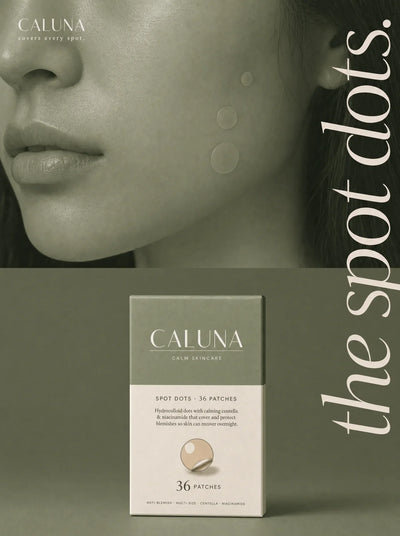
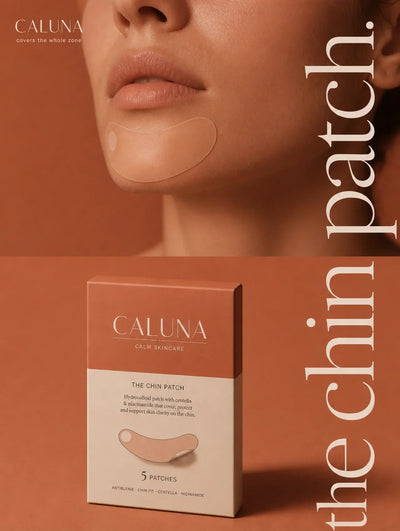
When a spot does surface on your nose, covering it does two useful things: it keeps your fingers off, and it protects the skin while it settles. That's what a hydrocolloid patch is known for — absorbing fluid and shielding the spot. Our Spot Dots are on sale now for the flatter parts of your face, but the nose is a curved, awkward little zone, which is exactly why we shaped a patch just for it. The Nose Patch — one T-shaped patch that hugs the bridge and the sides of the nose, in a simplified hydrocolloid formula with the final ingredient list published at launch — is coming in November; join the nose list to hear first.
We're building all of this out in public, one honest post at a time. Race update: nose 3 · chin 1 · forehead 1 · kids 1. The zone with the most names launches first on November 1st — pick yours.
— Jake, founder of Caluna.