
It's October 3rd, about four weeks out from Launch 2.0 on November 1st, and the nose list is still out front in our zone race. So here's a fitting question for today: why won't a pimple patch stay on your nose? The short answer is shape. Your nose is a curved, oily, constantly moving surface, and a flat round dot only grips where it can lie flat — so its edges lift on the slopes and it slides off.
Why does a pimple patch keep falling off your nose?
Because a flat dot can't sit flush on a curved surface. The nose bends in several directions at once, so a round patch really only touches the skin in the middle while its edges peel away from the slopes.
Hydrocolloid grips by sealing flat against the skin, and the edge is always the weak point. The tip, the bridge, the sides, and the little crease where your nose meets your cheek all curve differently, so a dot designed for a flat cheek never gets a fair shot at lying down. Add a few hours of talking, smiling, and wiping, and those lifted edges roll it right off.

Why is the nose so hard for any sticker to grip?
Two things work against it at once: curve and oil. The nose carries the highest density of oil glands on your whole face, and oil is the natural enemy of anything adhesive.
Even a patch that starts out pressed down well is fighting a surface that keeps producing oil underneath it. On a flatter, drier spot like a cheekbone, that same dot would happily stay put all night.
Do sweat and heat make it worse?
Yes. Sweat and warmth loosen the seal from underneath, and the nose sits right in the middle of the sweatiest stretch of your face.
If you're heading to the gym or out in Florida heat like I am most days, expect a nose patch to have a harder time than one on a dry forehead in the morning. Blotting the area first buys you some grip.
How do you get a patch to actually stay on your nose?
Put it on clean, completely dry skin and press the edges down hard. Most patches fail on the nose because of oil or moisture trapped under the rim, not because the patch is bad.
- Cleanse and let the skin dry fully — no serum, oil, or sunscreen under the patch.
- Blot the nose first if it runs oily, so the adhesive meets skin instead of grease.
- Press for a solid ten seconds, paying extra attention to every edge.
- Match the patch to the spot — a smaller dot on a flatter part of the nose stays better than a big one draped over a curve.
- Swap it once it's clouded over or an edge starts to lift, rather than pressing the old one back down.
Is a patch shaped for the nose actually different?
Yes — that's the whole point. A piece shaped to follow the nose and its sides touches far more skin and leaves fewer loose edges for a curve to peel up.
That's exactly why I've been building the Nose Patch: a single T-shaped piece that sits over the nose and down the sides in one go, instead of asking three or four round dots to cling to different slopes. It uses a simplified hydrocolloid formula, with the final ingredient list published at launch. It's coming in November — join the nose list if a curved nose is where your breakouts live.
What can you use on a nose spot right now?
For a surface spot that's come to a head, a hydrocolloid dot still works — it covers the spot, is known for absorbing the fluid it draws up, and keeps your fingers off it. You just have to press it on well and accept it may wander on the curviest parts.
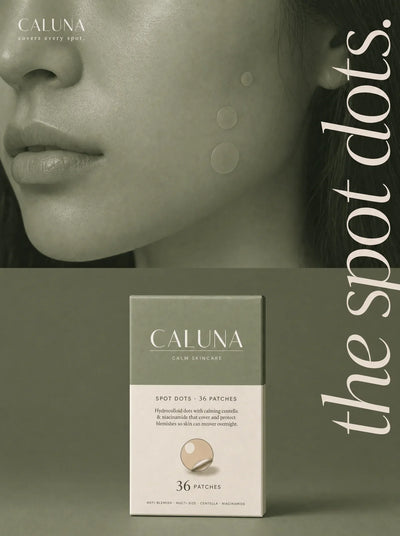
Our Spot Dots are available now — 36 invisible dots for $11.99, about 33¢ a dot — and they're the right tool for a single spot on a flatter patch of skin while the shaped Nose Patch is still on the way.
When should you see a dermatologist?
If spots on your nose are painful, deep, or keep coming back in the same place, that's worth a professional's eyes rather than another patch. A patch covers and protects a surface spot and keeps you from picking at it — it isn't a fix for a stubborn pattern.
Race update: nose 3 · chin 1 · forehead 1 · kids 1.
The zone with the most names launches first on November 1st — pick yours.
— Jake, founder of Caluna.